
Hermitages, shrines and temples of Dra Yerpa
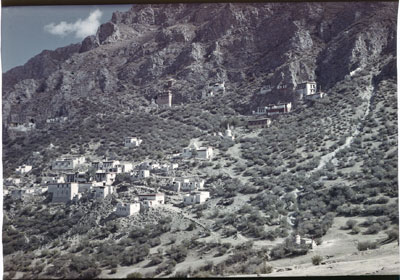
BMR.6.8.198 (Transparency colour)


Key Information
Photographer
Hugh E. Richardson
Collection
Hugh Richardson
Date of Photo
1936-50
Region
Lhasa Area > Dra Yerpa
Accession number
BMR.6.8.198
Image Dimensions
60 x 90 mm
Further Information
Photographic Process
Transparency Colour
Expedition
Hugh E. Richardson
Other Information
Technical Information - The camera used to take this collection of colour slides (Dufay colour) were a Zeiss Super Ikonta and a Reflex Korelle. [KC 09/10/2006]
Manual Catalogues -
Manual Catalogues - Typewritten handlist entitled 'Hugh Richardson Collection, The British Museum. Photographs taken between 1936-50. Cameras: Zeiss Super Ikonta, Reflex Korelle. 300 colour slides (Dufay colour); copies made Jan. 1995.
[no.] 198. The hermitage of Drak Yerpa, northeast of Lhasa.' [KC 11/10/2006]
Other Information - Location: Richardson describes the site in High Peaks, Pure Earth , London, Serindia Publications, 1998, "Four miles east of Lhasa itself stands the little monastery of Ri-skya , and beyond it the foundation of Brag Yer-pa (1937, 1948, 1950), lying at the head of a unexpectantly green an pleasant valley about twelve miles norht-east of Lhasa. The sheer cliff face is honeycombed with caves to which monks from the city came for meditation. It is a place of ancient sanctity and has been inhabited reputedly since the time of Srong-brtsan Sgam-po, whose cave with his image and those of his wives is high up on the cliff, reached only by a ladder. ... Near the foot of the hill in a small stone building was a large bronze bell in the T'ang style bearing in early north Indian characters the Buddhist formula ye dharma hetuprabhava etc and another sloka in Tibetan." (pp 305-6) [KC 20/10/2006]
For Citation use:
The Tibet Album.
"Hermitages, shrines and temples of Dra Yerpa"
05 Dec. 2006. The British Museum.
<http://tibet.prm.ox.ac.uk/photo_BMR.6.8.198.html>.
For more information about photographic usage or to order prints, please visit the The British Museum.
© The British Museum