
Yatung Oracle and his family at Galingka
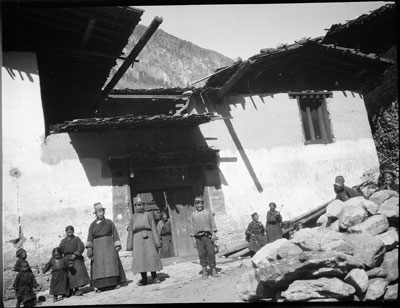
BMH.A.81.1 (Film negative)


 Compare

Key Information
Photographer
Arthur Hopkinson
Collection
A. J. Hopkinson
Date of Photo
January 30th 1927
Named Person
Yatung Oracle, Yatung Oracle's family
Region
Chumbi Valley Region > Galingka > Oracle's House
Accession number
BMH.A.81.1
Image Dimensions
85 x 113
Further Information
Photographic Process
Negative film nitrate
Expedition
A. J. Hopkinson's Tour of Duty as British Trade Agent, Gyantse, 1927-28
Other Information
In Negative - 'A81' has been written on the right edge of the negative in black ink. [MS 12/05/2006]
Notes on print/mount - One contact print made from this negative is contained in A. J. Hopkinson's negative case with the negative. The print appears to have been removed from an album, as there are traces of black mounting paper around the edges of the print as if it has been taken out after previously being glued in place. A partially decipherable caption has been written on the back in pencil: "Choji (in centre) in front of his house". The number 7 has been written on the front top right corner in pencil. [MS 26/06/2006]
Manual Catalogues -
Manual Catalogues - [Caption in A. J. Hopkinson's negative album 'Tibet A - A. J. Hopkinson ICS Gyantse via Siliguri]: 'Ditto [GA-LIN-KA] 'The Oracle' ' [MS 28/04/2006]
Other Information - Description: [Extract from taped interview, Richard Blurton and Mrs Hopkinson] 'The same [as 82: 'The oracle and his family outside their house'] - note the woman winding her thread with her mouth' [MS 20/04/2006]
Other Information - Dates
Other Information - Dates: For dating of image, see A. J. Hopkinson Archive, OIOC British Library, Mss Eur D998/53, Letters mainly from Gyantse 1926-27, diary dated January 30th 1927, page A [MS 26/06/2006]
For Citation use:
The Tibet Album.
"Yatung Oracle and his family at Galingka"
05 Dec. 2006. The British Museum.
<http://tibet.prm.ox.ac.uk/photo_BMH.A.81.1.html>.
For more information about photographic usage or to order prints, please visit the The British Museum.
© The British Museum