
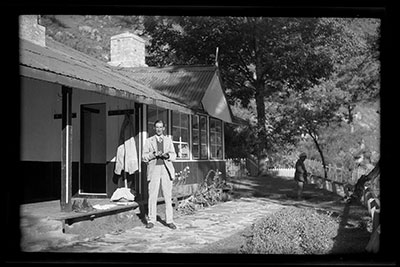
Richardson at Dak Bungalow at Champitang
2001.59.3.7.1 (Film negative)


 Compare

Key Information
Photographer
Unknown
Collection
Hugh Richardson
Date of Photo
c. July 11th 1936
Named Person
Hugh Richardson
Region
Chumbi Valley Region > Champithang
Accession number
2001.59.3.7.1
Image Dimensions
85 X 56 mm
Further Information
Photographic Process
Negative film nitrate
Date Acquired
Donated August 2001
Donated by
The executors of the estate of Hugh E. Richardson
Expedition
Hugh E. Richardson
Revised Photographer
David Macdonald? Pema Dawa?
Manual Catalogues -
Manual Catalogues - Notes on negative album - '3' 'MUG, LHOBRAG GORGE. GYANTSE. KHAMPA DANCERS. CHIPSHA MEN (?), CHOPA, APSOS, DREPUNG. NORBULING. DEKYI. POTALA'
Manual Catalogues -
Manual Catalogues - Notes on negative index - 'Chumpithag HR'
Manual Catalogues -
Manual Catalogues - Richardson's Hand List: 'Album no.3 [no.] 7. 'British Dak Bungalow in Tibet, north of the Nathu pass, Chumpitang.' [KC 02/10/2006]
Other Information - Setting
Other Information - Setting: Dak Bungalow literarily means post office. These buildings served as a post office and the trade agent's office, as well as a rest point and inn for colonial officers on tour. [TS 12/4/2005]
Other Information - Dates
Other Information - Dates: This image may have been taken when Richardson was en route to Lhasa for the first time in 1936, travelling with David Macdonald and Richardson's bearer Pema Dawa as far as Yatung, where they would meet some of the other members of the Mission party. The negative format is consistent with those that Richardson used in the early stages of the British Mission. The date he was at Champithang is derived from letters home to his parents in the manuscript archive at the Bodleian Library, Oxford University. This size of negative is quite distinctive in Richardson's collection and seems only to have been used before March 1937 [MS Or Richardson 3 folio 31] [MS 7/10/2005]
For Citation use:
The Tibet Album.
"Richardson at Dak Bungalow at Champitang"
05 Dec. 2006. The Pitt Rivers Museum.
<http://tibet.prm.ox.ac.uk/photo_2001.59.3.7.1.html>.
For more information about photographic usage or to order prints, please visit the The Pitt Rivers Museum.
© The Pitt Rivers Museum