
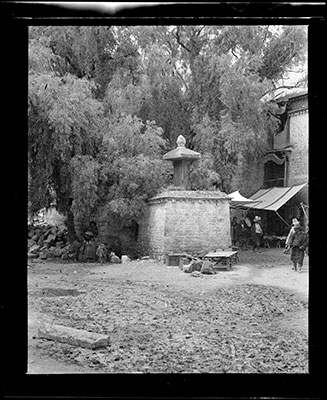
Treaty pillar outside the Jokhang in Lhasa
2001.59.2.72.1 (Film negative)


 Compare

Key Information
Photographer
Hugh E. Richardson
Collection
Hugh Richardson
Date of Photo
1950
Region
Lhasa > Jokhang > Doring
Accession number
2001.59.2.72.1
Image Dimensions
43 X 54 mm
Further Information
Photographic Process
Negative film nitrate
Date Acquired
Donated August 2001
Donated by
The executors of the estate of Hugh E. Richardson
Expedition
Hugh E. Richardson
Manual Catalogues -
Manual Catalogues - Notes on front of negative album in Richardson's hand in white: '2' 'Ramagang, 'Ushang, Tshurphu rgyal, Misc pillars'. On the reverse of negative album written in blue ink on white labels in Richardson's hand: 'Hu zhang, Pa blon chen, Pha bong ka, Nyenchen thang lho, Rva sgreng, Khro 'brug, etc. etc.' [KC 10/3/2006]
Manual Catalogues -
Manual Catalogues - Notes on negative index - Folio 71/72. 'Treaty Pillar at Tsug lag khang'.
Manual Catalogues -
Manual Catalogues - Richardson Hand List. 'Album No. 2 [no.] 50. Inscribed pillar near Jo-khang at Lhasa recording bilingual treaty between Tibet and China 821/822 A.D." [KC 09/11/2006]
In Negative - Notes on negative sleeve - '2 50'. [KC 09/11/2006]
Other Information - History: For a full translation of and commentary on the inscription see H. E. Richardson, A Corpus of Early Tibetan Inscriptions , London, 1985. Royal Asiatic Society, pp:106-143. Richardson remarks that "The bilingual inscription on a stone pillar outside the Jo-khang at Lhasa recording a treaty between Tibet and China is probably the most widely known and in many ways the most important of the early inscriptions from Tibet. ... " (p. 106) [KC 09/11/2006]
Other Information - Dates
Other Information - Dates: The date of 1950 for this image is derived from Richardson’s negative album No.4, the cover of which is marked with ‘Lhobrag 1950’. There are 16 images, of Chidesho, Gongkhar Dzong, Lhasa Post Office, Nesar, Yamdrok Tso and Shabsha, Karmaling Chu, Lhobrag, which share the same batch development number and seem to relate to a trip that Richardson took in this year. His preference for using 6x4.5 images, the smallest exposure size possible using his Zeiss Super Ikonta camera, seems to have returned only towards the end of his time in Tibet, possibly to maximise the number of images that he could take on each roll of film (16 using a film plane mask of this size or 8 at 6x9 cm) and this also suggests that the image wa taken at the end rather than the beginning of his residence in Tibet [MS 17/12/2005]
For Citation use:
The Tibet Album.
"Treaty pillar outside the Jokhang in Lhasa"
05 Dec. 2006. The Pitt Rivers Museum.
<http://tibet.prm.ox.ac.uk/photo_2001.59.2.72.1.html>.
For more information about photographic usage or to order prints, please visit the The Pitt Rivers Museum.
© The Pitt Rivers Museum