
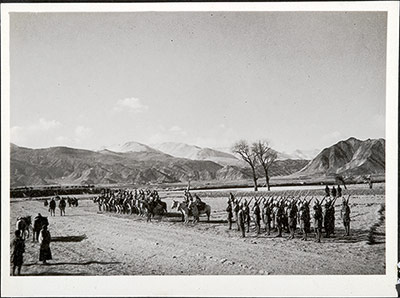
Review of troops at Gyantse, 1940
1999.23.1.33.1 (Album Print black & white)


 Compare

Key Information
Photographer
H. Staunton ?
Collection
Harry Staunton
Date of Photo
January - June 1940
Named Person
Sir Basil Gould, Hugh Richardson?, Innes-Keys?
Region
Gyantse
Accession number
1999.23.1.33.1
Image Dimensions
119 x 89 mm
Further Information
Activity
Administration
Photographic Process
Print gelatin silver
Date Acquired
Donated 1999
Donated by
Diana Hughes
Expedition
H. Staunton
Photo also owned by
Diana Hughes
Other Information
Notes on print/mount - "Guard of Honour. 1/15 Punjab Reg. Gyantse" is written in blue ink on the reverse of the image. Also, the number: 468V is written in pencil in the top right hand corner. [KC 11/1/2006]
Notes on album mount - "Gyantse" is written in pencil and in capital letters in the centre of the page as a joint caption for the four photographs on this page of the album. [KC 11/1/2006]
Manual Catalogues -
Manual Catalogues - "The Escort is aligned" [Hugh Richardson in conversation with Roger Croston, detailed in H. Staunton undated Related Documents File, PRM Manuscript Collections]
Other Information - Setting
Other Information - Setting: Alex McKay writes about the Gyantse Trade Agency in Tibet and the British Raj , 1997, Richmond: Curzon Press, "On 1 October 1904, with no formalities beyond raising the flag, the Gyantse Trade Agency began operations in Chang Lo ('Willow Garden'), a country house which the younghusband mission had used as its Gyantse base. In addition to local employees, O'Connor [the British Trade Agent] had a number of European staff. There was a British officer of the India Medical Service ... and a military escort consisting of 50 India soldiers, which was normally under the command of a British officer. There was also a European Head Clerk to oversee clerical staff recruited from the Darjeeling area, two Indian Army telegraph sergeants responsible for communications and a third in charge of supply and transport.'(p. 17) The structure of the administration remained very much the same until the demise of the Agency in 1948 [?]. Gyantse was selected because it was seen to be a commercially important meeting point of trade routes from India, Shigatse and Lhasa. [KC 11/1/2006]
For Citation use:
The Tibet Album.
"Review of troops at Gyantse, 1940"
05 Dec. 2006. The Pitt Rivers Museum.
<http://tibet.prm.ox.ac.uk/photo_1999.23.1.33.1.html>.
For more information about photographic usage or to order prints, please visit the The Pitt Rivers Museum.
© The Pitt Rivers Museum