
Dra Yerpa Monastery
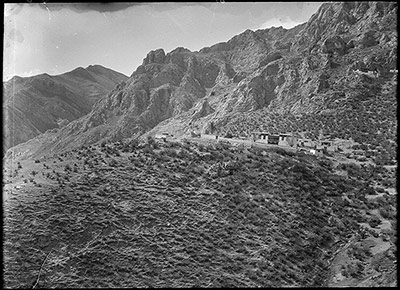
1998.285.65 (Glass negative)


 Compare

Key Information
Photographer
Sir Charles Bell or Rabden Lepcha?
Collection
Sir Charles Bell
Date of Photo
September 10th - 11th 1921
Region
Lhasa Area > Dra Yerpa
Accession number
1998.285.65
Image Dimensions
120 x 163 mm
Further Information
Photographic Process
Negative glass plate gelatin , Negative Half Plate
Date Acquired
Donated 1983
Donated by
St Antony's College, Oxford.
Expedition
Sir Charles Bell's Mission to Lhasa 1920-21
Photo also owned by
Royal Central Asiatic Society
Previous Catologue Number
See H.61
Previous Pitt Rivers Museum Number
BL.H.61a
Manual Catalogues -
Manual Catalogues - Bell's List of Illustrations entry for H.61: "[No. of chapter] IV. [Subject of Chapter] History up to 1900. [Subject of illustration] H61 (o) Ditto [ref.: H.60 and P35 in index - Trayerpa Monastery] left portion. O is the rock; in a cave in this rock Atisha lived for a year. This monastery has 108 chotens; in the larger are the ashes of Atisha's main disciples; in the smaller ones are clay images made by Atisha." Although in the index entry for H.6 Bell refers to 'X' on the image marking the place where Lopon Rimpoche lived for one or two years (the 'Moon Cave'), it is not clear in this case whether 'O' refers to a marking made on the image in some other context (not visible on the contact prints for this entry, 1998.285.65 & 1998.285.66) or whether it refers to the sub-numbering system that is adopted in this list, where entry H.6 is also identified as '(o)'. [MS 14/5/2004]
Other Information - Related Images
Other Information - Related Images: Bell does not distinguish in his list of illustrations between 1998.285.65 & 1998.285.66 although they are separate images. 1998.285.66 appears to be slightly better focused. The main visual referent to the chortens described in Bell's list entry is in fact to be seen in H.60 [1998.285.63 & 1998.285.64] [MS 25/02/2006]
Other Information - Setting
Other Information - Setting: Bell's Diary entry for 10th September 1921:"In the afternoon we visit the most sacred chapels on this monastery. They are made out of caves high up in the hill-side, the rock here being apparently of limestone. There are said to be 108 (the sacred number) caves altogether, some of which are used as chapels. // We see first the small cave where Atisha dwelt. Then a large cave, containing a clay image, gilt over, of Gye-wa Champa. The lower half was made by human hands, but the upper half is believed to have made itself. It is about 28 feet high. Shesur is greatly interested in it, because the hands are in a position ( mudra ) which he has never seen in an image of Gye-wa Champa." [Diary Vol. XII, pp. 84-85]
For Citation use:
The Tibet Album.
"Dra Yerpa Monastery"
05 Dec. 2006. The Pitt Rivers Museum.
<http://tibet.prm.ox.ac.uk/photo_1998.285.65.html>.
For more information about photographic usage or to order prints, please visit the The Pitt Rivers Museum.
© The Pitt Rivers Museum