
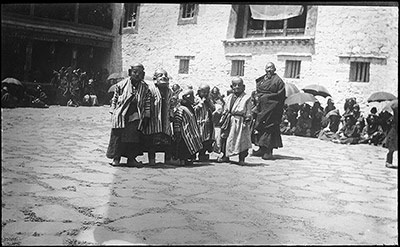
Dancers at Kungtang, near Lhasa
1998.285.600 (Glass negative)


 Compare

Key Information
Photographer
Lt Col R. S. Kennedy? Willoughby Patrick Rosemeyer?
Collection
Sir Charles Bell
Date of Photo
May 21st 1921 or May 1922?
Region
Lhasa Area > Kungtang > Monastery
Accession number
1998.285.600
Image Dimensions
138 x 88 mm
Further Information
Activity
Performing
Photographic Process
Negative glass plate gelatin , Copy Negative
Date Acquired
Donated 1983
Donated by
St Antony's College, Oxford.
Copy difference
Copy Neg
Expedition
Sir Charles Bell's Mission to Lhasa 1920-21
Photo also owned by
Royal Central Asiatic Society
Revised Photographer
Not Bell?
Previous Catologue Number
P.564
Previous Pitt Rivers Museum Number
BL.P.564
Related Collections
British Library, Oriental and India Office Collections
Manual Catalogues -
Manual Catalogues - Bell's List of Illustrations entry: "[No. of chapter] LXVI. [Subject of Chapter] Festivals. [Subject of illustration] P.564 (gl) (b) Children of Jin-da Ha-shang, the Mongolian, at the dance at Kung-tang, near Lhasa"
Other Information - Photographer: Bell did not use P-sized or 'Postcard' sized negatives of the kind with which this image is made for his images of Lhasa in 1920-21. However, Lt Col Robert Kennedy, who was with Bell in 1920-21, did so, as did W. P. Rosemeyer, who visited Lhasa many times from 1922 onwards as a telegraph officer involved with establishing the telegraph line to Lhasa. This is a copy of a print, not an original image, and the print may well have been acquired by Bell from one of these sources [MS 25/02/2006]
Other Information - Setting
Other Information - Setting: On May 20th according to Bell's Diary, he travelled to Kungtang, 5 miles from Lhasa up the Kyi Chu Valley, to witness the religious ceremonies that commemorated the birth of Gotama Buddha, the enlightenment of Gotama Buddha and the Buddha's entry into Nirvana. Bell describes the ceremonies in some detail in his Diary for May 21st 1921:"The whole performance is, as usual, in the courtyard of the monastery. Seated on the ground round the sides are the ordinary spectators, and in verandahs and rooms round are those of the upper classes. The Tsendron tells me that by watching these dances spectators not only have the pleasure of watching the show, but gain religious merit ( ge-wa ) also. ... The Black Hat dance is followed by a dance executed by eight Atsaras. This says the Tsendron , is the only dance executed by the Atsaras in Central Tibet. The Atsaras, who are the servants of the Chyokyongs, are represented as Indians, (for both the Chyokyongs and their servants are supposed to be Indians). They have large noses, large, round, staring eyes, big mouths with prominant teeth, thin cheekbones and thin bodies. // Next comes a dance of Chyokyongs. The Tsendron stops this for a moment (not at my suggestion) and [?] Rabden to take a photograph of it for me. And so with some of the later dances." [Diary Vol. X, pp. 67-68]
For Citation use:
The Tibet Album.
"Dancers at Kungtang, near Lhasa"
05 Dec. 2006. The Pitt Rivers Museum.
<http://tibet.prm.ox.ac.uk/photo_1998.285.600.html>.
For more information about photographic usage or to order prints, please visit the The Pitt Rivers Museum.
© The Pitt Rivers Museum