
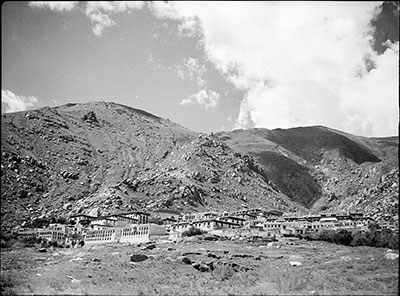
Drepung Monastery from below
1998.131.353.1 (Film negative)


 Compare

 Compare

Key Information
Photographer
Frederick Spencer Chapman
Collection
Frederick Spencer Chapman
Date of Photo
August 30th 1936
Region
Lhasa Area > Drepung
Accession number
1998.131.353.1
Image Dimensions
83 x 109
Further Information
Photographic Process
Negative film nitrate , Negative Quarter Plate
Date Acquired
Donated 1994
Donated by
Faith Spencer Chapman
Expedition
British Diplomatic Mission to Lhasa 1936-37
Photo also owned by
Frederick Spencer Chapman
Previous Catologue Number
C.2.7 [view film roll]
Previous Pitt Rivers Museum Number
SC.T.2.353
Other Information
In Negative - '7' has printed on the bottom of the negative [MS 21/03/2006]
Other Information - Related Images
Other Information - Related Images: It has been possible to identify this image because of the number printed on the bottom of the negative. It relates to the group of images prefixed 'C.2.' which comprise a group of negatives containing images of the treasurer, a panorama from Drepung, views from Sera and Nechung monastery. They seem all to have been taken on August 30th 1936 [MS 12/03/2006]
Other Information - Setting
Other Information - Setting: "Being Sunday Gould had arranged to have a rest from visitors and arranged a visit to Drepung Gompa, the biggest gompa in Tibet or in the world for that matter. ... The gompa is like a great town on a steeply rising hillside 5 miles out of Lhasa and the numerous buildings, halls and temples rise perforce in terraces with steep alleys and steps between. ... We then proceeded to the "Nachung" or temple of the Great Oracle of Tibet, a mile from Drepung Gompa, where we had a pic-nic lunch under a grove of trees at which we entertained our Tibetan guides and our own clerks, who had accompanied us to Drepung, much to their delight" ['Lhasa Mission, 1936: Diary of Events', p.7, written by Philip Neame] [MS 12/03/2006]
Other Information - Description: "Drepung is supposed to house 7700 monks, but sometimes as many as 10,000 live there. The name Dre-pung literally means "the pile of rice", which is what the monastery resembles as its tiers of whitewashed buildings lie one behind the other on a sloping site at the head of a wedge-shaped valley. Looked at from a distance Drepung resembles a large fortified city rather than a single monastery, and it is only when one climbs the steep mountain slopes behind it and looks down on to its innumberable ramifications that one gets a true idea of its immense size. Looked at from below it is foreshortened and many of the buildings are dwarfed or hidden" ['Lhasa: The Holy City', F. Spencer Chapman, London: Chatto & Windus, 1938, p. 195] [MS 21/03/2006]
Other Information - Historical Background: Founded In 1416 by a disciple of Tsongkhapa, Jamyang Choje. Was the centre of political power in Tibet before the Potala and after continued to be an active presence. Gelug-pa Sect, commonly known as the Yellow Hat Sect, the Reformed Sect of Buddhism it means 'the Virtuous People'. [Marina de Alarc’n ZF 1995.1]
For Citation use:
The Tibet Album.
"Drepung Monastery from below"
05 Dec. 2006. The Pitt Rivers Museum.
<http://tibet.prm.ox.ac.uk/photo_1998.131.353.1.html>.
For more information about photographic usage or to order prints, please visit the The Pitt Rivers Museum.
© The Pitt Rivers Museum