
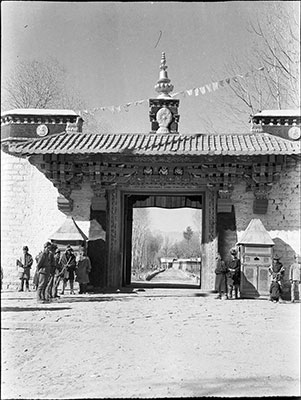
Entrance to Norbu Lingka
1998.131.324 (Film negative)


 Compare

Key Information
Photographer
Unknown Photographer
Collection
Frederick Spencer Chapman
Date of Photo
December 1936?
Region
Lhasa > Norbu Lingka > Gate
Accession number
1998.131.324
Image Dimensions
110 x 80 mm
Further Information
Photographic Process
Negative film nitrate
Date Acquired
Donated 1994
Donated by
Faith Spencer Chapman
Expedition
British Diplomatic Mission to Lhasa 1936-37
Photo also owned by
Frederick Spencer Chapman
Revised Photographer
Not Chapman
Previous Pitt Rivers Museum Number
SC.T.2.324
Other Information
In Negative - The number '9' has been printed on the negative in the bottom right hand corner [MS 29/4/2005]
Research publication - Clare Harris and Tsering Shakya (eds.) 'Seeing Lhasa: British Depictions of the Tibetan Capital 1936-1947', Chicago: Serindia Publications, 2003, p.23
Exhibition - This image appeared in the 2003 Temporary Exhibition at the Pitt Rivers Museum "Seeing Lhasa: British Depictions of the Tibetan Capital 1936-1947"
Other Information - Photographer: It seems that this image may not have been taken by F. Spencer Chapman. It was made using a quarter plate sized negative, but of a slightly different size to that which Chapman used in his Zeiss Super Ikonta camera. Furthermore, this image does not relate to any negatives numbered '9' in Chapman's handlist of images made whilst he was in Lhasa [MS 20/03/2006]
Other Information - Dates
Other Information - Dates: A possible date of December 1936 has been given for this image because of internal evidence from the photograph [defoliation of the trees] [MS 20/03/2006]
Other Information - Setting
Other Information - Setting: The entrance gateway to the Norbu Lingka (“The Jewel Park”), the Dalai Lama’s summer palace in Lhasa. The Norbhu Lingka was built at the close of the nineteenth century and consists of a large walled enclosure containing a number of buildings. Chapman described the entrance in some detail: “The main gate is most impressive, with a roof of highly glazed tiles and the usual golden medallions on a background of dark red. On each side and above the gate is a system of branching woodwork painted red and picked out with flower-designs in bright colours. A row of grinning white demons look down from beneath the roof. The heavy wooden doors, with metal knockers formed by a ring held in the jaws of a lion, open into a portico, the ceiling of which is richly painted. It is a pity that the square pillars here are of granite which has been treated in the same way as wood, for the stone looks out of place and its surface is little suited to paintwork”. ( Lhasa the Holy City , London: Readers Union, 1940, p.183)
Other Information - Related Images
Other Information - Related Images: Both 1998.131.325 [C.20.9] and 1998.131.330 [C.20.7] appear to have been taken on the same day. However, in one carpets have been placed on the floor in front of the throne and in the other they are absent [MS 20/03/2006]
Other Information - Setting
Other Information - Setting: The Dalai Lama's bodyguard were housed in barracks adjacent to the Norbhu Lingka. Chapman described them in his book Lhasa the Holy City: "The nominal strength of this bodyguard is 500, but many of the soldiers were on leave. The barracks face the river and are separated from it by a stony parade-ground where the troops play football. ... There was always a guard in the sentry-box beside the gate. When we gave notice of our intention to visit the palace, there would be a section ready in charge of an N.C.O. They were usually youths, not so tall as the fixed bayonets they carried - it was necessary to have their bayonets fixed as they carried no ammunition" [ Lhasa the Holy City , London: Readers Union, 1940, p.189] [MS 20/03/2006]
For Citation use:
The Tibet Album.
"Entrance to Norbu Lingka"
05 Dec. 2006. The Pitt Rivers Museum.
<http://tibet.prm.ox.ac.uk/photo_1998.131.324.html>.
For more information about photographic usage or to order prints, please visit the The Pitt Rivers Museum.
© The Pitt Rivers Museum