
Horpa woman
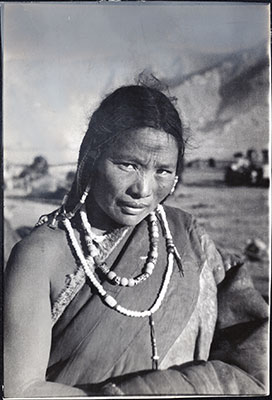
1998.131.230 (Print black & white)


 Compare

 Compare
Key Information
Photographer
Frederick Spencer Chapman
Collection
Frederick Spencer Chapman
Date of Photo
January 7th 1937
Region
Lhasa Area
Accession number
1998.131.230
Image Dimensions
169 x 117 mm
Further Information
Photographic Process
Print gelatin silver
Date Acquired
Donated 1994
Donated by
Faith Spencer Chapman
Expedition
British Diplomatic Mission to Lhasa 1936-37
Photo also owned by
Frederick Spencer Chapman
Previous Catologue Number
BI.15 In publication
'Lhasa Mission 1936, Diary of Events', P. Neame, H. Richardson, F. S. Chapman, Government of India Political Department [Note: photographs for October 18th - November 4th 1936 are not included as their relationship to text is not detailed; see Mission Diary text for details of images] [see photos in publication]
Previous Pitt Rivers Museum Number
SC.T.2.230
Published
'Lhasa Mission 1936, Diary of Events', P. Neame, H. Richardson, F. S. Chapman, Government of India Political Department [Note: photographs for October 18th - November 4th 1936 are not included as their relationship to text is not detailed; see Mission Diary text for details of images] [view list of illustrations]
Other Information
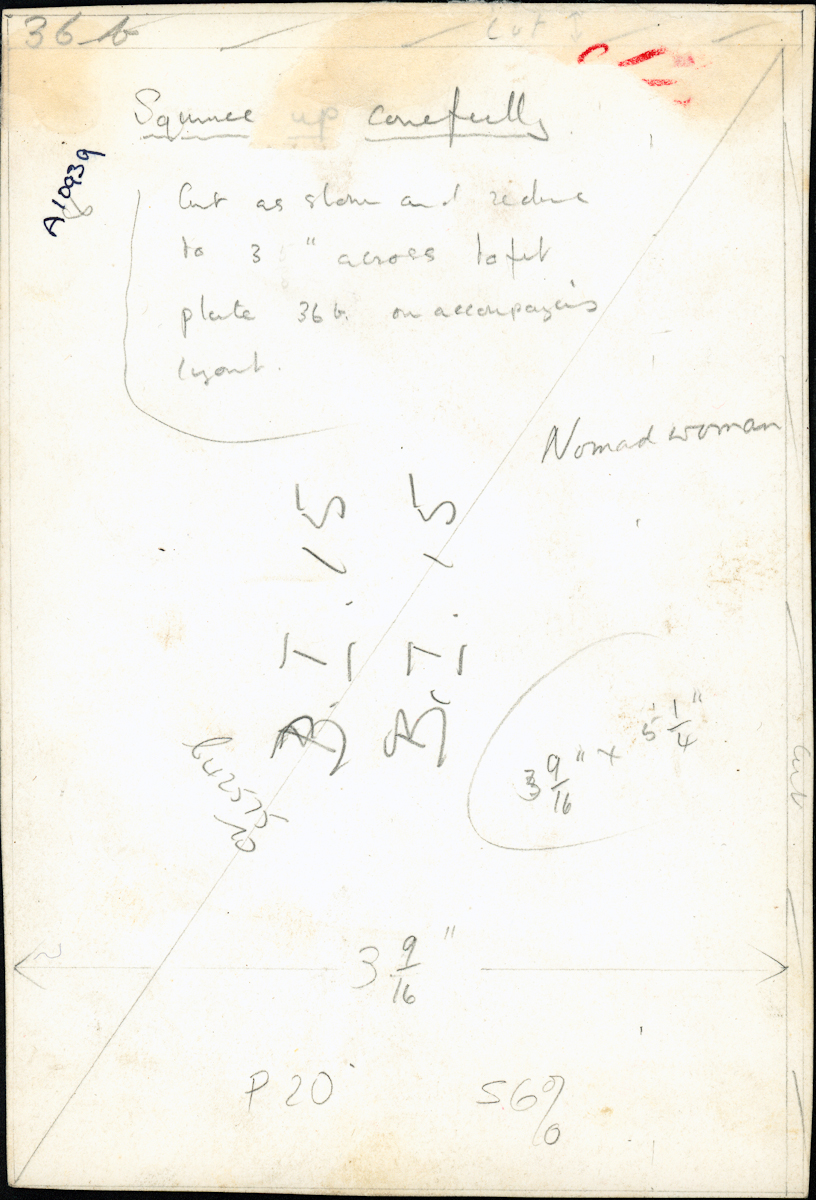
Notes on print/mount - The back of the print is covered with crop and proof marks and instructions on how to reproduce the image. Included amongst these are the instructions to "Square up carefully" and "Cut as shown and reduce to 3 [inches] across to fit plate 36b on accompanying layout". There are also a variety of referencing annotations such as 'B.I.15' written twice in pencil in the middle of the back of the print, and '36b' in the top left corner. The caption 'Nomad Woman' has also been added in the centre right of the print back. Many of these various annotations seem to have been added by different people and at different times. There is evidence of a piece of thin paper being stuck to the top of the back of the print, which would have been used to transfer the crop markings to the front. There is also evidence of a red crayon being used to mark up or number the image in some way, as is seen on many of these images in the Chapman Collection that were edited for reproduction [MS 3/2/2005]
Manual Catalogues -
Manual Catalogues - Caption in Chapman's hand-written list of negatives made whilst on the Mission to Lhasa, 1936-7 [See PRM Manuscripts Collection]: 'Ditto Ditto [Mongolian woman] close. V. [Vertical]'; PRM Manuscripts Collection: ‘List of Tibetan Prints and Negatives’ - Book 4: ‘7/3 - Detail of nomad woman’s jewellery’ [MS 16/03/2006]
Other Information - Related Images
Other Information - Related Images: Images prefixed with 'BI.' comprise a group of negatives containing images of the Lord Chamberlain, the Rumba family, Khampa people, Mongolian women, Lhasa, Iamtso, Lalu Se and Lalu Monastery. They all appear to have been taken on or around January 7th 1937 [MS 16/03/2006]
Contemporary Publication -
Contemporary Publication - This image seems to have been used to illustrate a description of nomad women in text of the official Mission Diary for January 7th 1937. In the 'Appendix to Diary Part XII - Explanatory List of Photographs with Lhasa Mission' he captions this image 'Nomad woman from the Chang Tang'. On this day Chapman went out to the outskirts of Lhasa early in the morning, at dawn, to photograph some of the nomads who had arrived in the city to trade, pay taxes in kind at the Potala and go on the pilgrimage routes around the city. The text which this illustration is intended to support is as follows: "The women, who are remarkably handsome, wear their hair in innumerable minute plaits which are attached at shoulder level to a multi-coloured piece of canvas which hangs down almost to the ground". In his publication Lhasa the Holy City [London: Chatto & Windus, 1938; reprint, London: Readers Union Ltd., 1940, pp. 158-160] he gives a fuller description of the activities of the nomads upon arrival in the city, as well as a fuller description of the style of women's dress that this image seems to have been intended to illustrate: "The women wear a long full robe of sheepskin with the fur on the inside. Often one arm and shoulder is slipped out of the garment, and it is then clear that nothing is worn beneath" [1940, 1938, p.159] [MS 18/3/2005]
Other Information - Cultural Background
Other Information - Cultural Background: True dzi stones are a type of fossil considered to be auspicious. The more eyes the stone has the more auspicious it is supposed to be. As Well As Herding, These People Carried Salt From The North To Trade In The South . [Marina de Alarc’n ZF 1995.1]
For Citation use:
The Tibet Album.
"Horpa woman"
05 Dec. 2006. The Pitt Rivers Museum.
<http://tibet.prm.ox.ac.uk/photo_1998.131.230.html>.
For more information about photographic usage or to order prints, please visit the The Pitt Rivers Museum.
© The Pitt Rivers Museum